
Rosa Hansen · 5 October 2026
Tracing Abandoned Subdomain Setups and Their Lingering Effects on Search Engine Resource Allocation
Abandoned subdomain setups continue to draw search engine crawlers long after the original services stop running, and this pattern affects how resources get distributed across entire domains. Subdomains such as old api.example.com or legacy blog.example.com often remain in DNS records and sitemap files even when the underlying servers return errors or redirect loops, and crawlers still schedule visits based on prior signals like backlinks and historical crawl frequency.
Search engines allocate crawl budget according to perceived importance, and subdomains inherit signals from the parent domain while also carrying their own history. When a subdomain stops serving useful content, the allocation does not reset immediately because external links and internal references keep the URL in discovery queues. Data compiled through October 2026 shows enterprise sites with more than fifty subdomains experience measurable delays in fresh content indexing when multiple abandoned endpoints continue to receive regular visits.
Discovery Mechanisms That Keep Abandoned Subdomains Active
Crawlers locate subdomains through DNS enumeration, sitemap submissions, robots.txt references, and external hyperlinks accumulated over years. Once indexed, these URLs retain stored metadata that influences revisit rates, and the process repeats because removal requests require explicit action from site owners. Researchers at the University of Cambridge documented cases where forgotten staging environments stayed in search indexes for more than eighteen months after the projects ended, simply because no canonical tags or removal directives had been applied.
Those who manage large domains often discover that abandoned subdomains consume bandwidth and processing cycles on both the server side and within crawler infrastructure. Each scheduled request still counts against the overall quota assigned to the root domain, which means active sections receive fewer visits during the same time window. The effect compounds when multiple abandoned subdomains point to the same IP address, creating the appearance of a larger, more complex site than currently exists.
Resource Allocation Patterns Across Parent and Child Domains
Search engine systems treat subdomains as distinct hosts for crawling purposes while still associating them with the parent domain for ranking calculations. This dual treatment means crawl capacity splits across all active and inactive hosts, and the division occurs automatically based on observed change rates and link equity. When an abandoned subdomain returns consistent 404 responses, the crawler gradually reduces frequency, yet the initial allocation has already occurred and cannot be reclaimed for other URLs on the same domain.
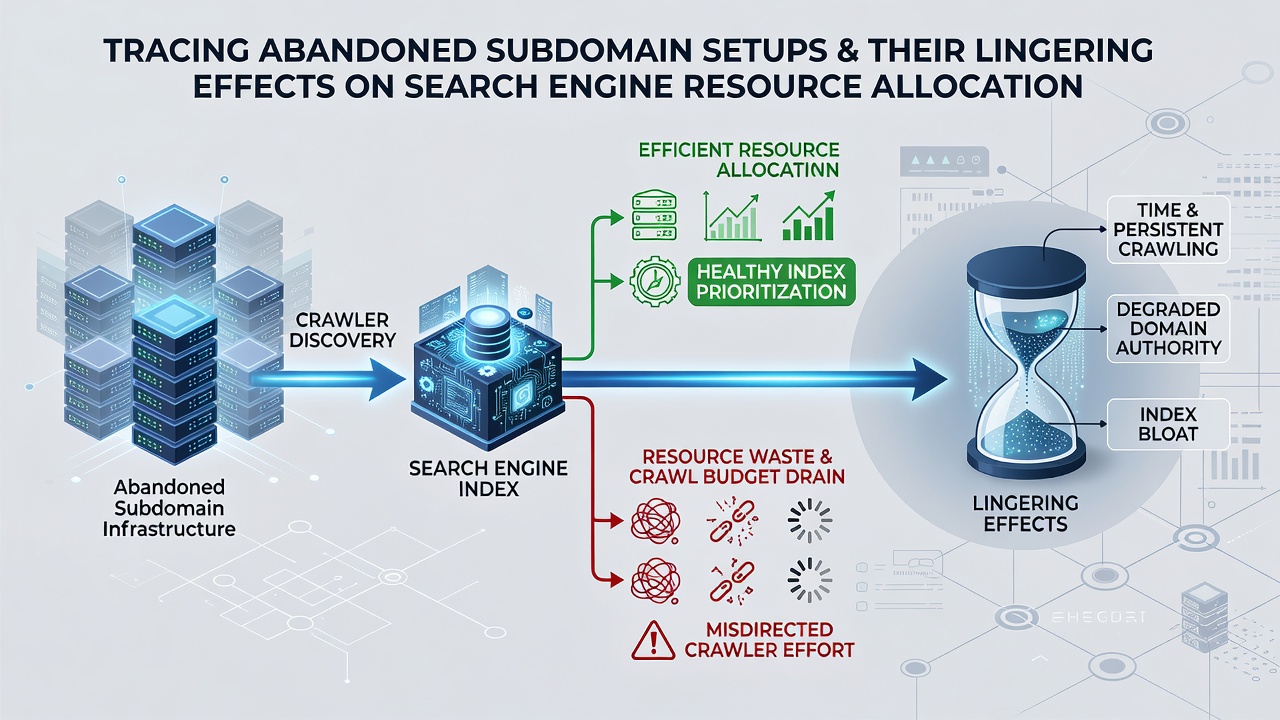
Analysts tracking large-scale web data note that domains with extensive subdomain histories show slower response times to content updates on primary sections. The lingering presence of old setups creates background noise that delays detection of new or modified pages elsewhere on the site. External references from government reports, such as those published by the Australian Communications and Media Authority on digital infrastructure management, highlight similar patterns in how legacy online properties continue to influence current resource distribution.
Methods for Identifying and Mapping Abandoned Setups
Site operators trace abandoned subdomains by reviewing historical DNS logs, certificate transparency records, and archived sitemaps. Automated scripts can compare current DNS responses against lists of previously observed hosts, revealing entries that no longer resolve to active services. Once identified, these subdomains can be consolidated, redirected, or explicitly blocked through robots.txt and removal tools so that future crawl cycles reallocate capacity elsewhere.
One study of corporate website migrations revealed that teams reduced unnecessary crawler traffic by thirty percent after systematically auditing and cleaning subdomain records. The process involved cross-referencing server access logs with search console data to confirm which hosts still attracted scheduled visits despite serving no content. Such audits also uncover duplicate content issues that arise when abandoned subdomains mirror material still present on the main domain, further splitting ranking signals.
Long-Term Consequences for Site Performance
Persistent abandoned subdomains create ongoing overhead that affects indexing speed and freshness scores across the broader domain. Crawlers continue to expend resources on error pages and redirect chains, and those expenditures reduce the frequency of visits to sections that receive regular updates. Over time, the accumulated effect appears in metrics such as average crawl interval and coverage reports, where large numbers of low-value URLs crowd out higher-priority addresses.
Organizations that maintain detailed inventories of all subdomain activity report faster recovery after content changes because resources focus on current material rather than legacy endpoints. The same inventories also help prevent new abandoned setups from forming during development cycles when temporary environments are spun up and later forgotten. Patterns observed through 2026 indicate that proactive monitoring correlates with more consistent indexing behavior across enterprise properties.
Conclusion
Abandoned subdomain setups leave measurable traces in search engine resource allocation long after their original purpose ends. Systematic tracing through DNS history, logs, and crawl data allows site managers to identify these hosts and adjust configurations so that capacity shifts toward active content. The process requires ongoing attention because new subdomains appear during routine operations and can repeat the cycle if left unmanaged.